message in the stars
If God really exists, why in Heaven’s names does God not prove that he exists instead of leaving us here in our terrible uncertainty? Why does he not show his face so that at last a despairing world can have hope? At one time or another, everyone asks such a question. In some objectifiably verifiable and convincing way, we want God himself to demonstrate his own existence. Deep in our hearts, I suspect that his is what all of us want, unbelievers no less than believers. And I have wondered sometimes what would happen if God were to do just that. What would happen if God did set about demonstrating his existence in some dramatic and irrefutable way?
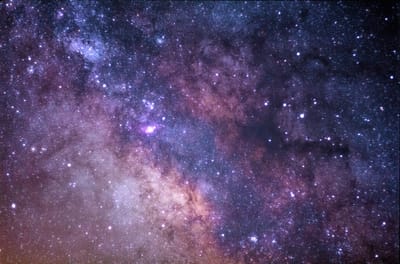
Suppose, for instance, that God were to take the great dim river of the Milky way as we see it from down here flowing across the night sky and were to brighten it up a little and then rearrange it so that all of a sudden one night the world would step outside and look up at the heavens and see not the usual haphazard of stars but, written out in letters light years tall, the sentence: I REALLY EXIST, or GOD IS. If I were going to try to write a story or a play about such an event, I would start, of course, with the first night that this great theological headline appeared there in the stars, with suns and moons to dot the i’s and the tails of comets to cross the t’s. And I would try to show some of the ways that I can imagine people might respond to it. I would show some of them sinking to their knees, not because they are especially religious people but just because it might seem somehow the only natural thing to do under the circumstances. They would perhaps do it without even thinking about it, just crumpling down to their knees there in the tall grass out behind the garage. Some of them I would show running back into their houses in terror – guilty ones in terror of judgment, sophisticated ones in terror at the stark and terrible simplicity of it – just GOD IS written up there in the fire just the sheer and awesome vastness of the Unknown suddenly making itself known.
There would be a good many tears of regret, I suspect – people thinking that if only they had known it before, what different lives they might have had. And in many a person the sudden, wild upsurge of hope – the sick old man lying in bed where he cannot sleep and looking through his bedroom window. On the table his clock ticktocks his time away, but there in the sky he sees proof at last of a reality beyond time. And I would want to touch at least on the peculiar astonishment of preachers and theologians who spend so much of their lives talking about God that unless they are very careful, God starts to lose all reality for them and to become just a subject for metaphysical speculation. For them too there would be this great affirmation in the night, and they would discover that they had been right after all, more right than perhaps they have every quite been able to believe, and they would marvel at the strangeness of it.
What I would be trying to suggest in my story would be that the initial impact of God’s supplying the world with this kind of objective proof of his existence would be extraordinary. But as my story ended, I am afraid that in honesty I would have to suggest something else.
Several years would go by and God’s proof of himself would still be blazing away every night for all to read. In order to convince people that the message was not just some million-to-one freak of nature, I would be tempted to have God keep on rewriting it in different languages, sometimes accompanying it with bursts of pure color or with music so celestial that finally the last hardened skeptic would be convinced that God must indeed exist after all. Then the way that I would have to end it might be this. I would have a child look up at the sky some night, just a plain, garden-variety child with perhaps a wad of bubble gum in his cheek. If this were to be a movie, I would have a close-up here of just the child’s eyes with the stars reflected in them, and I would have him spell out the message syllable by syllable. And deep in the heaves there would be the usual strains of sublime music. And then I would have the child turn to his father, or maybe, with the crazy courage of childhood, I would have him turn to God himself, and the words that I would have speak would be “So what if God exists?” he would say. “What difference does that make?” And in the twinkling of an eye the message would fade away for good and the celestial music would be heard no more, or maybe they would continue for centuries to come, but it would no longer make any difference.
We all want to be certain, we all want proof, but the kind of proof that we tend to want – scientifically or philosophically demonstrable that would silence all doubts once and for all – would not in the long run, I think, answer the fearful depths of our need at all. For what we need to know, of course, is not just that God exists, not just that beyond the steely brightness of the stars there is a cosmic intelligence of some kind that keeps the whole show going, but that there is a God right there in the thick of our day-to-day lives who may not be writing messages about himself in the stars but who in one way or another is trying to get messages through our blindness as we move around down here knee-deep in the fragrant muck and misery and marvel of the world. It is not objective proof of God’s existence that we want but, whether we use religious language for it or not, the experience of God’s presence. That is the miracle that we are really after. And that is also, I think, the miracle that we really get.
I believe that we know much more about God than we admit that we know, than perhaps we altogether know that we know. God speaks to us, I would say, much more often than we realize or than we choose to realize. Before the sun sets every evening, he speaks to each of us in an intensely personal and unmistakable way. His message is not written out in starlight, which in the long run would make no difference; rather, it is written out for each of us in the humdrum, helter-skelter events of each day; it is a message that in the long run might just make all the difference.
Who knows that he will say to me today or to you today in the midst of what kind of unlikely moment he will choose to say it. Not knowing is what makes today a hold mystery as every day is a holy mystery. But I believe that there are some things that by and large God is always saying to each of us. Each of us carries around inside himself, I believe, a certain emptiness – a sense that something is missing, a restlessness, a deep feeling that somehow all is not right inside his skin. Part of the inner world of everyone is this sense of emptiness, unease, incompleteness, and I believe that this in itself is a word from God, that this is the sound that God’s voice makes in a world that has explained him away. In such a world, I suspect that maybe God speaks to us most clearly through our missing him.
Our days are full of nonsense, and yet not, because it is precisely into the nonsense of our days that God speaks to us words of great significance – not words that are written in the stars but words that are written into the raw stuff and nonsense of our days, which are not nonsense just because God speaks into the midst of them. And the words he says, to each of us differently, are be brave … be merciful … feed my lambs …press toward the goal.
The words that God speaks to us in our lives are the real miracles. They are not miracles that create faith as we might think that a message in the stars would create faith, but they are miracles that it takes faith to see – faith in the sense of openness, faith in the sense of willingness to wait, to watch, to listen, for the incredible presence of God here in the world among us.
~Frederick Buechner
Suppose, for instance, that God were to take the great dim river of the Milky way as we see it from down here flowing across the night sky and were to brighten it up a little and then rearrange it so that all of a sudden one night the world would step outside and look up at the heavens and see not the usual haphazard of stars but, written out in letters light years tall, the sentence: I REALLY EXIST, or GOD IS. If I were going to try to write a story or a play about such an event, I would start, of course, with the first night that this great theological headline appeared there in the stars, with suns and moons to dot the i’s and the tails of comets to cross the t’s. And I would try to show some of the ways that I can imagine people might respond to it. I would show some of them sinking to their knees, not because they are especially religious people but just because it might seem somehow the only natural thing to do under the circumstances. They would perhaps do it without even thinking about it, just crumpling down to their knees there in the tall grass out behind the garage. Some of them I would show running back into their houses in terror – guilty ones in terror of judgment, sophisticated ones in terror at the stark and terrible simplicity of it – just GOD IS written up there in the fire just the sheer and awesome vastness of the Unknown suddenly making itself known.
There would be a good many tears of regret, I suspect – people thinking that if only they had known it before, what different lives they might have had. And in many a person the sudden, wild upsurge of hope – the sick old man lying in bed where he cannot sleep and looking through his bedroom window. On the table his clock ticktocks his time away, but there in the sky he sees proof at last of a reality beyond time. And I would want to touch at least on the peculiar astonishment of preachers and theologians who spend so much of their lives talking about God that unless they are very careful, God starts to lose all reality for them and to become just a subject for metaphysical speculation. For them too there would be this great affirmation in the night, and they would discover that they had been right after all, more right than perhaps they have every quite been able to believe, and they would marvel at the strangeness of it.
What I would be trying to suggest in my story would be that the initial impact of God’s supplying the world with this kind of objective proof of his existence would be extraordinary. But as my story ended, I am afraid that in honesty I would have to suggest something else.
Several years would go by and God’s proof of himself would still be blazing away every night for all to read. In order to convince people that the message was not just some million-to-one freak of nature, I would be tempted to have God keep on rewriting it in different languages, sometimes accompanying it with bursts of pure color or with music so celestial that finally the last hardened skeptic would be convinced that God must indeed exist after all. Then the way that I would have to end it might be this. I would have a child look up at the sky some night, just a plain, garden-variety child with perhaps a wad of bubble gum in his cheek. If this were to be a movie, I would have a close-up here of just the child’s eyes with the stars reflected in them, and I would have him spell out the message syllable by syllable. And deep in the heaves there would be the usual strains of sublime music. And then I would have the child turn to his father, or maybe, with the crazy courage of childhood, I would have him turn to God himself, and the words that I would have speak would be “So what if God exists?” he would say. “What difference does that make?” And in the twinkling of an eye the message would fade away for good and the celestial music would be heard no more, or maybe they would continue for centuries to come, but it would no longer make any difference.
We all want to be certain, we all want proof, but the kind of proof that we tend to want – scientifically or philosophically demonstrable that would silence all doubts once and for all – would not in the long run, I think, answer the fearful depths of our need at all. For what we need to know, of course, is not just that God exists, not just that beyond the steely brightness of the stars there is a cosmic intelligence of some kind that keeps the whole show going, but that there is a God right there in the thick of our day-to-day lives who may not be writing messages about himself in the stars but who in one way or another is trying to get messages through our blindness as we move around down here knee-deep in the fragrant muck and misery and marvel of the world. It is not objective proof of God’s existence that we want but, whether we use religious language for it or not, the experience of God’s presence. That is the miracle that we are really after. And that is also, I think, the miracle that we really get.
I believe that we know much more about God than we admit that we know, than perhaps we altogether know that we know. God speaks to us, I would say, much more often than we realize or than we choose to realize. Before the sun sets every evening, he speaks to each of us in an intensely personal and unmistakable way. His message is not written out in starlight, which in the long run would make no difference; rather, it is written out for each of us in the humdrum, helter-skelter events of each day; it is a message that in the long run might just make all the difference.
Who knows that he will say to me today or to you today in the midst of what kind of unlikely moment he will choose to say it. Not knowing is what makes today a hold mystery as every day is a holy mystery. But I believe that there are some things that by and large God is always saying to each of us. Each of us carries around inside himself, I believe, a certain emptiness – a sense that something is missing, a restlessness, a deep feeling that somehow all is not right inside his skin. Part of the inner world of everyone is this sense of emptiness, unease, incompleteness, and I believe that this in itself is a word from God, that this is the sound that God’s voice makes in a world that has explained him away. In such a world, I suspect that maybe God speaks to us most clearly through our missing him.
Our days are full of nonsense, and yet not, because it is precisely into the nonsense of our days that God speaks to us words of great significance – not words that are written in the stars but words that are written into the raw stuff and nonsense of our days, which are not nonsense just because God speaks into the midst of them. And the words he says, to each of us differently, are be brave … be merciful … feed my lambs …press toward the goal.
The words that God speaks to us in our lives are the real miracles. They are not miracles that create faith as we might think that a message in the stars would create faith, but they are miracles that it takes faith to see – faith in the sense of openness, faith in the sense of willingness to wait, to watch, to listen, for the incredible presence of God here in the world among us.
~Frederick Buechner